Why ChatGPT cites competitors instead of your website
Why ChatGPT cites competitors, review sites, or the wrong URL instead of your website, plus a practical source-gap workflow to fix competitor citations.
When ChatGPT cites a competitor instead of your website, the painful part is not the lost link. It is the evidence gap. The answer may still know your brand, but it trusts another page more for the exact buyer question.
Use the fast decision rule: if ChatGPT mentions you but cites a competitor, fix the source page. If it cites neither you nor your competitor, fix category clarity first. If it cites your domain but the wrong URL, fix internal links and page targeting.
This guide shows how to diagnose the loss, classify the source gap, improve the intended page, and re-measure the same prompt set. If you already track ChatGPT citation rate, use this as the fix workflow behind the metric. For a cross-surface comparison of competing brands and sources, run an answer engine optimization competitor analysis.
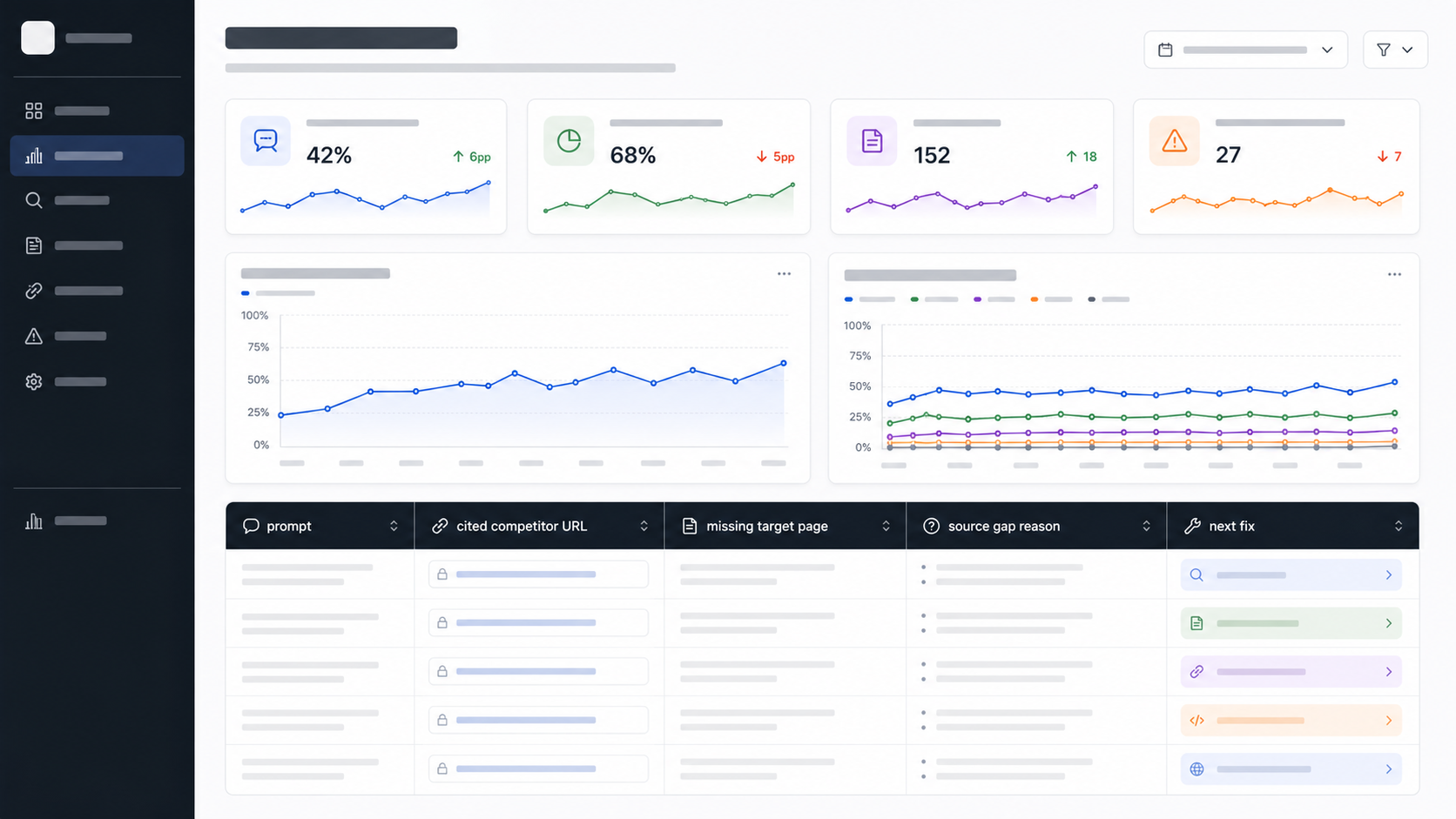
Why does ChatGPT cite competitors instead of your website?
ChatGPT cites competitors when their pages, third-party mentions, or source ecosystem better match the prompt than your target URL. The reason is usually not one magic ranking factor. It is a source gap: the competitor has a clearer page, fresher proof, better entity coverage, stronger third-party validation, or a cited URL that matches the hidden intent better.
A ChatGPT source gap is the difference between the source ChatGPT used and the source you expected it to use. The gap can be content structure, proof, freshness, crawl access, third-party evidence, internal links, or simple intent mismatch.
OpenAI explains that ChatGPT Search can show sources for answers. For marketers, that makes the citation visible enough to audit: inspect what was cited, decide why that source won, then improve the URL that should have answered the prompt.
What should you check first when a competitor is cited?
Start by separating four outcomes: brand mention, domain citation, target URL citation, and competitor citation. Do not treat them as the same event. Each outcome points to a different fix, and blending them creates vague advice like "make better content."
Use this triage table:
| ChatGPT outcome | What it means | First action |
|---|---|---|
| Your brand is mentioned, competitor is cited | You are known, but the competitor owns the evidence | Improve the intended source page and add proof |
| Competitor is recommended and cited, you are absent | Category/entity clarity is weak | Build or rewrite the page that matches the buyer prompt |
| Your domain is cited, wrong URL is cited | Source mapping is unclear | Add internal links and clarify the canonical target page |
| Review site, Reddit, or publisher is cited | The answer wants independent evidence | Improve your page and earn third-party proof |
| No sources are shown | ChatGPT may not be using search for that prompt | Track mention quality and test related source-seeking prompts |
This is why ChatGPT citation tracking should record cited URLs, not only brand names. A brand mention tells you whether you are in the answer. A cited URL tells you which page shaped the answer.
How do you find the exact source gap?
Find the source gap by comparing the cited competitor page against your intended page line by line. Look at the first answer block, title, URL, headings, tables, examples, sources, FAQ, schema, update date, and internal links. The winning page usually makes the answer easier to assemble.
Run this 20-minute audit:
- Save the exact prompt and ChatGPT answer.
- Copy every cited URL and label the cited domain.
- Pick the page on your site that should have won.
- Compare the top 500 words of the cited page and your page.
- Check whether your page answers the prompt in the first 40-80 words.
- Check whether your page includes the entity terms the prompt implies.
- Check whether the cited page has a better table, source, example, or comparison.
- Decide whether the fix is page copy, proof, schema, internal links, crawl access, or third-party validation.
For example, a prompt like "why does ChatGPT cite competitors instead of my website" is not just a ChatGPT SEO prompt. It implies citations, competitor source share, source gaps, answer-engine optimization, AI visibility tracking, cited URLs, brand mentions, and page fixes. The page that names those entities naturally is easier to select.
Which page should you fix when ChatGPT cites a competitor?
Fix the page that should have owned the prompt, not necessarily the page that ranks highest in Google. In AI search, the most useful target page is the URL that directly answers the buyer's question and can support a citation without forcing the model to infer too much.
Use this decision table:
| Prompt type | Best target page | What to add |
|---|---|---|
| "Why does ChatGPT cite competitors?" | Failure-mode guide | Cause table, diagnosis workflow, fix checklist |
| "How do I track ChatGPT citations?" | Tracking workflow | Prompt set, metrics, cited URL fields, report format |
| "What is a good citation rate?" | Benchmark guide | Intent-weighted bands and re-measurement rules |
| "Best ChatGPT SEO tools" | Tool comparison page | Criteria, use cases, limitations, pricing-adjacent answers |
| "Tracemetry vs Profound" | Comparison page | Feature-by-feature table and honest fit guidance |
| "Why is the wrong URL cited?" | Source-mapping guide | Internal link map, canonical checks, target URL logic |
If no page matches the prompt, create one. If a page exists but buries the answer, rewrite it. If the right page exists and is already strong, the missing piece may be external evidence: reviews, partner pages, case studies, community mentions, or trusted publisher coverage.
How do you rewrite a page so ChatGPT can cite it?
Rewrite the page so the answer, entities, proof, and next step are obvious. The goal is not to stuff keywords. The goal is to remove ambiguity for a source-selection system and for the human who lands on the page.
Use this fix order:
- Put a direct 40-80 word answer immediately under the H1 or the relevant H2.
- Add one table that compares symptoms, causes, and fixes.
- Name the exact entities: ChatGPT Search, cited URLs, competitor citations, brand mentions, target URL citation rate, AI visibility, and prompt monitoring.
- Replace vague claims with examples, screenshots, source links, or observed prompt outcomes.
- Add visible FAQ answers that match the schema.
- Link from related pages such as ChatGPT SEO, ChatGPT SEO prompts, and content that AI assistants cite.
- Send the reader to the right conversion path, such as a free AI visibility audit or Tracemetry Pro, only after the practical advice is complete.
Google's structured data documentation is a useful constraint here: markup should describe visible page content. Treat FAQ and Article schema as a clarity layer, not a hidden ranking trick. If the answer is not visible on the page, schema will not save it.
What competitor citation fixes actually move the metric?
The fixes that move the metric are usually boring and specific: answer the prompt earlier, use the same entities the buyer uses, add a useful comparison table, cite reliable sources for factual claims, and link from pages that already own nearby intent. Big rewrites are less reliable than precise source-gap fixes.
Prioritize fixes in this order:
| Priority | Fix | Why it works |
|---|---|---|
| 1 | Add or rewrite the direct answer | The source page becomes easier to extract |
| 2 | Add a diagnosis or comparison table | The answer has structured facts to reuse |
| 3 | Clarify the intended URL with internal links | The right page becomes the obvious source |
| 4 | Add fresh proof | The page feels current and defensible |
| 5 | Match FAQ/schema to visible answers | The machine-readable layer matches the page |
| 6 | Earn third-party mentions | Independent evidence helps evaluative prompts |
Do not chase every competitor citation. Fix the prompts closest to revenue first: comparison, alternatives, shortlist, pricing-adjacent, implementation, and failure-mode questions. A competitor citation on a generic definition prompt is annoying. A competitor citation on "best AI visibility tool for B2B SaaS" is expensive.
How do you re-measure after the fix?
Re-measure with the exact same prompts after the page is live, crawlable, internally linked, and fetched. Compare brand mention rate, domain citation rate, target URL citation rate, competitor source share, and answer accuracy. The win is not "we published the fix." The win is that the same prompt now uses your page or stops using the competitor page.
Use this weekly report:
| Field | Record |
|---|---|
| Prompt | The exact buyer question |
| Intended URL | The page that should be cited |
| Prior cited URL | Competitor, publisher, forum, or wrong internal URL |
| Loss reason | Missing page, weak answer, weak proof, stale page, wrong URL, third-party proof gap |
| Fix shipped | Copy, table, schema, internal links, sources, or proof |
| New result | Mentioned, domain cited, target URL cited, competitor still cited, or absent |
| Next action | Keep, expand, earn proof, or rewrite a different page |
Give each fix a fair window before judging it. The point is not to refresh one prompt until it agrees with you. The point is to build a stable prompt-monitoring loop where page changes, crawler access, citations, and competitor source share are tracked together.
FAQ
Why does ChatGPT cite competitors even when my site ranks in Google? ChatGPT can cite competitors when their page is a better source for the prompt, even if your site performs well in traditional search. Ranking helps discovery, but citation selection also depends on answer structure, source match, entity clarity, freshness, proof, and whether the page answers the exact question.
What is the fastest way to fix competitor citations in ChatGPT? Pick one high-intent prompt, identify the cited competitor URL, improve the intended page with a direct answer, decision table, current proof, visible FAQ, and internal links, then re-measure the same prompt after the page is live.
Should I create a new page every time ChatGPT cites a competitor? No. Create a new page only when no existing URL matches the prompt intent. If the right page already exists, improve that page and strengthen internal links. Too many overlapping pages can make the wrong URL problem worse.
Are third-party citations bad for my brand? Not always. A trusted review site, partner page, or publisher mention can validate your brand. The problem is when third-party pages define your positioning, omit your best use cases, or send the buyer to competitors. Track third-party source share separately from owned citations.
How many prompts should I track to find competitor citation gaps? Start with 40-80 prompts across category, shortlist, comparison, alternatives, workflow, failure-mode, and pricing-adjacent questions. That is enough to find repeatable source gaps without drowning the team in one-off answers.
Turn competitor citations into a fix queue
The wrong response is "ChatGPT hates our site." The useful response is "which source did it trust, which page should have won, and what one fix would make that page easier to cite?"
Run the free Tracemetry audit to find prompts where competitors own the cited source slot. Then use Tracemetry Pro to track ChatGPT citations, competitor source share, target URL citation rate, and the page fixes that change the next run.
Sources: OpenAI ChatGPT Search help, Google structured data documentation, Semrush on AI tools citing third-party sources, OpenAI crawlers.
Frequently asked questions
Why does ChatGPT cite competitors even when my site ranks in Google?
ChatGPT can cite competitors when their page is a better source for the prompt, even if your site performs well in traditional search. Ranking helps discovery, but citation selection also depends on answer structure, source match, entity clarity, freshness, proof, and whether the page answers the exact question.
What is the fastest way to fix competitor citations in ChatGPT?
Pick one high-intent prompt, identify the cited competitor URL, improve the intended page with a direct answer, decision table, current proof, visible FAQ, and internal links, then re-measure the same prompt after the page is live.
Should I create a new page every time ChatGPT cites a competitor?
No. Create a new page only when no existing URL matches the prompt intent. If the right page already exists, improve that page and strengthen internal links. Too many overlapping pages can make the wrong URL problem worse.
Are third-party citations bad for my brand?
Not always. A trusted review site, partner page, or publisher mention can validate your brand. The problem is when third-party pages define your positioning, omit your best use cases, or send the buyer to competitors. Track third-party source share separately from owned citations.
How many prompts should I track to find competitor citation gaps?
Start with 40-80 prompts across category, shortlist, comparison, alternatives, workflow, failure-mode, and pricing-adjacent questions. That is enough to find repeatable source gaps without drowning the team in one-off answers.
See your own AI visibility today.
Free public report. 60 seconds. No signup. Or get started on Pro to track 250 prompts continuously.