ChatGPT SEO Audit: a 7-Layer Checklist for 2026
Run a ChatGPT SEO audit across buyer prompts, citations, brand accuracy, competitor sources, target pages, crawl access, and repeatable measurement.
Your team can publish polished pages for months and still have no idea why ChatGPT names a competitor, cites an old URL, or gets your product wrong. The painful part is not a lack of content. It is the absence of a repeatable audit that connects each lost buyer question to one fixable source.
The fast rule is simple: audit 40–60 buyer prompts, preserve the full answers and citations, then fix the five highest-value losses. Do not begin with a site-wide rewrite. A focused ChatGPT SEO audit should tell you where you are absent, which source wins, what fact or proof is missing, and which page should own the answer.
What is a ChatGPT SEO audit?
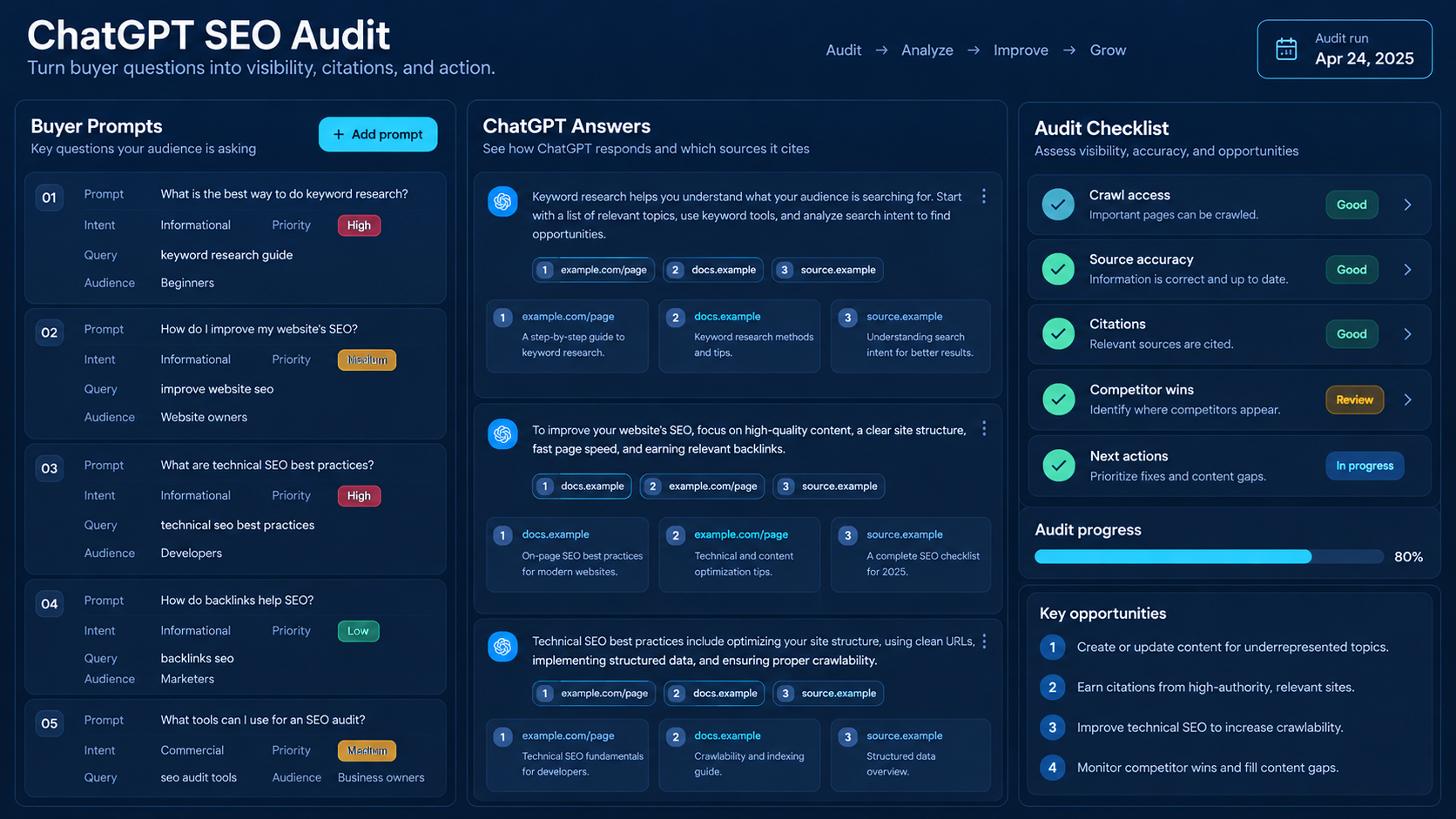
A ChatGPT SEO audit is a structured review of how ChatGPT discovers, describes, cites, and recommends a brand across a fixed set of buyer questions. It tests answer visibility, citation ownership, factual accuracy, competitor presence, source-page quality, crawl access, and the path from each lost prompt to a concrete page or authority fix.
A ChatGPT SEO audit is an evidence-to-action workflow, not a one-time screenshot exercise. It should preserve the prompt, complete answer, cited URLs, date, market, account conditions, brand outcome, and next action for every test.
OpenAI explains that ChatGPT Search can use information from the web and show source links. OpenAI also says publishers that want their pages included in summaries and snippets should allow OAI-SearchBot. Those two facts make both technical access and source quality part of the audit, but neither guarantees a citation or recommendation.
What should you check first in a ChatGPT SEO audit?
Check high-intent answer outcomes before auditing every technical detail. If ChatGPT never recommends your brand for the questions closest to a purchase, that is a larger commercial problem than a missing citation on an educational prompt. Start with outcomes, trace them to sources, then inspect the pages and access conditions behind the losses.
Use this order:
| Audit layer | Question to answer | Passing condition |
|---|---|---|
| Recommendation | Does ChatGPT present the brand as a suitable option? | The brand appears for qualified, relevant buyer needs |
| Citation | Does ChatGPT cite the intended domain and page? | The source supports the claim and matches the prompt |
| Accuracy | Are product, pricing, capability, and policy claims correct? | Material claims match current first-party sources |
| Competition | Which brands and domains win instead? | Competitor wins have an explainable source advantage |
| Page ownership | Is there one clear URL for the question? | One accessible page gives the best complete answer |
| Access | Can search crawlers reach the page and assets? | Robots, status, canonical, and rendering checks pass |
| Measurement | Can the same test be repeated? | Prompt, conditions, answer, sources, and date are saved |
This sequence reduces wasted effort. A crawler fix cannot make a weak page persuasive, and a perfect article cannot help when the intended URL is blocked or canonicalized elsewhere.
Which prompts belong in the audit?
Use 40–60 natural buyer questions across discovery, shortlisting, comparison, alternatives, workflow, trust, and failure modes. Keep one market, language, audience, and product scope per cohort. The prompts should force useful decisions rather than merely repeat a keyword.
A practical first cohort includes:
- 8 discovery prompts: “What is the best way to solve [problem]?”
- 10 shortlist prompts: “What are the best [category] tools for [audience]?”
- 8 comparison prompts: “[Brand] versus [competitor] for [job]?”
- 6 alternative prompts: “What is the best alternative to [competitor]?”
- 8 workflow prompts: “How do I complete [job] with less effort?”
- 6 trust prompts: “Which [category] supports [requirement or proof]?”
- 6 failure-mode prompts: “Why does [process] fail when [constraint]?”
Do not seed every question with your brand name. Unbranded prompts reveal genuine category visibility; branded prompts reveal whether ChatGPT describes you accurately. Use the ChatGPT SEO prompt framework when you need a complete prompt library, then lock the reporting cohort before collecting the baseline.
How do you score each ChatGPT answer?
Score recommendation, mention, citation, target-page match, and accuracy separately. A brand can be mentioned but not recommended, recommended without a citation, or cited through the wrong page. Combining those outcomes into one visibility score hides the diagnosis.
For each prompt run, record:
- Outcome: absent, mentioned, recommended, or recommended first.
- Citation: whether your domain appears as a source.
- Target match: whether ChatGPT cites the page that should own the question.
- Accuracy: correct, incomplete, stale, or materially wrong.
- Competitor win: the brand and source that received the answer slot.
- Action: access fix, page improvement, consolidation, proof, or external authority.
Calculate rates only after preserving the raw evidence. ChatGPT citation tracking explains the source fields, while ChatGPT share of voice shows how to compare approved brand mentions without mixing them with citations.
How do you audit the winning and losing sources?
Compare the intended page with the source ChatGPT actually used. Look for the smallest defensible advantage: a clearer definition, current specification, direct comparison, named methodology, original data, visible limitation, expert attribution, or stronger third-party corroboration. The goal is to close the evidence gap, not copy a competitor's prose.
Use this decision table:
| Observed loss | Likely cause | First action |
|---|---|---|
| No brand and no citation | Discovery, relevance, or authority gap | Confirm access, then improve the intended page and supporting mentions |
| Brand named, competitor cited | Weak source ownership | Add the missing proof or answer block to the target page |
| Old URL cited | Canonical or page-role ambiguity | Consolidate duplicates and strengthen links to the current source |
| Wrong product fact | Conflicting source truth | Reconcile product page, docs, schema, feeds, and profiles |
| Competitor recommended first | Better fit evidence | Publish explicit use-case, limitation, comparison, and proof sections |
| Answer changes every run | Ambiguous prompt or volatile retrieval | Add constraints and repeat samples before changing content |
If a competitor citation keeps winning, use the deeper competitor citation diagnosis. A page should earn the answer because it resolves the buyer's question with stronger evidence, not because it repeats “ChatGPT SEO” more often.
What technical checks belong in the audit?
Verify that the intended page returns a clean 200 response, is allowed for relevant search crawling, has a self-referencing canonical, appears in the sitemap, renders its important text without fragile client-only behavior, and links from discoverable pages. Then confirm metadata and structured data accurately match visible content.
Technical checklist:
- Test
robots.txtrules forOAI-SearchBotand normal search crawlers. - Check HTTP status, redirect chain, canonical, indexability, and sitemap inclusion.
- Confirm the decisive answer exists in rendered HTML.
- Verify internal links point to the intended source with descriptive context.
- Remove or consolidate duplicate pages competing for the same question.
- Keep product, pricing, policy, author, and update facts consistent.
- Validate Article, FAQ, Product, or SoftwareApplication markup where relevant.
- Confirm images, documents, and cited assets do not return blocked responses.
Schema can reduce ambiguity, but it cannot guarantee that ChatGPT retrieves, cites, or recommends a page. Treat structured data as a faithful machine-readable description of visible content, not a hidden persuasion layer.
How do you turn audit findings into a priority list?
Prioritize each loss by buyer intent, commercial value, factual harm, fix confidence, and effort. The best first action is usually a high-intent prompt with a clear target page and an obvious evidence gap. That produces a faster learning loop than rewriting a broad pillar page.
Use this simple sequence:
- Fix materially wrong claims that could mislead a buyer.
- Repair access, canonical, rendering, or duplicate-page failures.
- Improve target pages for high-intent prompts where competitors win.
- Add missing comparisons, limitations, proof, and concise answer blocks.
- Strengthen internal links and relevant third-party corroboration.
- Wait until the changes are accessible, then rerun the unchanged prompts.
Every action should name one prompt, one desired outcome, one target URL, one observed gap, one owner, and one re-test date. “Improve AI visibility” is not a task.
How often should you repeat a ChatGPT SEO audit?
Run a full baseline once, review the stable high-value cohort weekly during an active sprint, and summarize movement monthly. Recheck affected prompts after major product, pricing, policy, positioning, or page changes. Keep exploratory prompts separate so trend reports do not shift every time the question set changes.
A useful 30-day cadence is:
- Week 1: lock the cohort and capture complete answers and sources.
- Week 2: repair accuracy, access, duplication, and target-page gaps.
- Week 3: improve five high-value source pages and supporting links.
- Week 4: rerun the same prompts and compare outcomes and citations.
Measure recommendation rate, first-named rate, domain citation rate, target-page citation rate, material-claim accuracy, competitor source share, and qualified AI referral conversions separately. If you need a reporting format, pair the audit with the AI search visibility report.
FAQ
What is a ChatGPT SEO audit? A ChatGPT SEO audit reviews how ChatGPT discovers, describes, cites, and recommends a brand across a fixed buyer-prompt set. It connects recommendation, citation, accuracy, competitor, source-page, and crawl-access evidence to a prioritized list of fixes.
How many prompts should a ChatGPT SEO audit include? Start with 40–60 prompts for one audience, product scope, market, and language. Cover discovery, shortlist, comparison, alternatives, workflow, trust, and failure modes. Expand only after the team can inspect every result and act on the losses.
Can a ChatGPT SEO audit guarantee citations? No. No audit, schema type, or page change can guarantee a ChatGPT citation or recommendation. An audit improves the evidence, access, source clarity, and measurement process that make useful visibility gains more likely and diagnosable.
What is the fastest ChatGPT SEO audit fix? Fix the highest-intent prompt where a competitor wins and your intended page has one clear evidence gap. Add the missing answer, comparison, proof, limitation, or current fact, then rerun the unchanged prompt after the page is accessible.
Should I audit ChatGPT mentions or citations? Audit both separately. Mentions show brand presence; recommendations show commercial inclusion; citations show source ownership. A brand can win one and lose the others, so one combined metric cannot explain the next action.
How often should I run a ChatGPT SEO audit? Capture a full baseline once, review priority prompts weekly during active optimization, and report the stable cohort monthly. Recheck after important product, policy, pricing, positioning, or source-page changes.
Find the five losses worth fixing first
Run a free Tracemetry audit to capture where ChatGPT mentions, recommends, and cites your brand against competitors. Then use Tracemetry Pro to keep the prompt cohort stable, preserve source evidence, assign page fixes, and prove whether the unchanged questions improve after deployment.
Sources: OpenAI publisher and developer FAQ, OpenAI: searching the web with ChatGPT, Google: creating helpful, reliable, people-first content, Google: canonicalization, Schema.org FAQPage.
Frequently asked questions
What is a ChatGPT SEO audit?
A ChatGPT SEO audit reviews how ChatGPT discovers, describes, cites, and recommends a brand across a fixed buyer-prompt set. It connects recommendation, citation, accuracy, competitor, source-page, and crawl-access evidence to a prioritized list of fixes.
How many prompts should a ChatGPT SEO audit include?
Start with 40–60 prompts for one audience, product scope, market, and language. Cover discovery, shortlist, comparison, alternatives, workflow, trust, and failure modes. Expand only after the team can inspect every result and act on the losses.
Can a ChatGPT SEO audit guarantee citations?
No. No audit, schema type, or page change can guarantee a ChatGPT citation or recommendation. An audit improves the evidence, access, source clarity, and measurement process that make useful visibility gains more likely and diagnosable.
What is the fastest ChatGPT SEO audit fix?
Fix the highest-intent prompt where a competitor wins and your intended page has one clear evidence gap. Add the missing answer, comparison, proof, limitation, or current fact, then rerun the unchanged prompt after the page is accessible.
Should I audit ChatGPT mentions or citations?
Audit both separately. Mentions show brand presence; recommendations show commercial inclusion; citations show source ownership. A brand can win one and lose the others, so one combined metric cannot explain the next action.
How often should I run a ChatGPT SEO audit?
Capture a full baseline once, review priority prompts weekly during active optimization, and report the stable cohort monthly. Recheck after important product, policy, pricing, positioning, or source-page changes.
See your own AI visibility today.
Free public report. 60 seconds. No signup. Or get started on Pro to track 250 prompts continuously.