Answer Engine Optimization for Cybersecurity Companies
A practical AEO playbook for cybersecurity companies: govern product claims, map buyer questions to approved sources, monitor errors, and measure citations.
Cybersecurity buyers now ask AI assistants which vendors fit a specific stack, control framework, deployment model, or incident workflow. If the answer cites an outdated review, confuses your product category, or repeats an unsupported claim, your team can lose the shortlist before a demo is booked.
Use this fast rule: track 30–50 high-intent security questions, assign one approved source page to each, and fix factual errors before chasing more mentions. The goal is not to make an AI say your name everywhere. It is to earn accurate recommendations for the questions your product can genuinely answer.
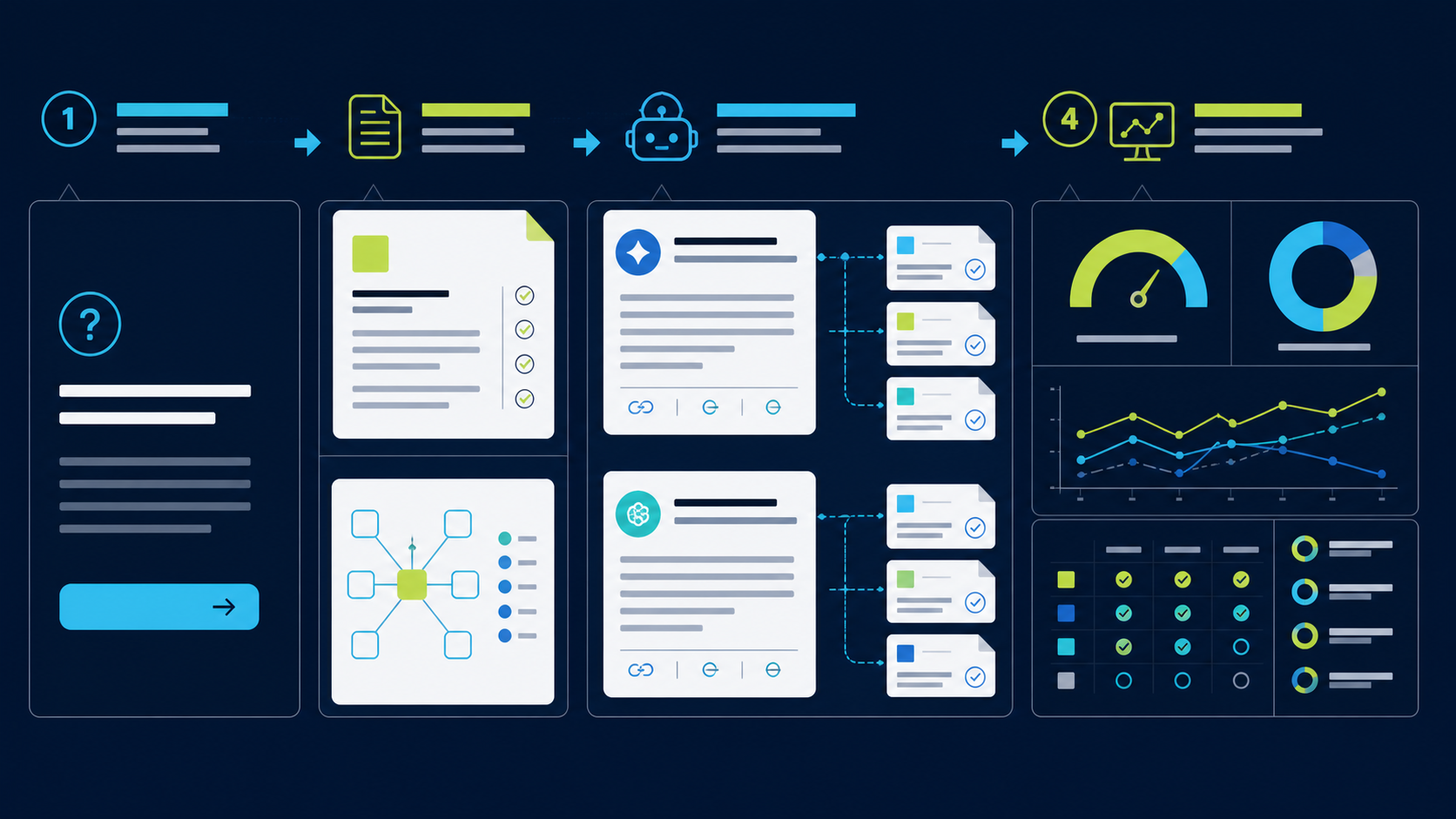
This guide applies the broader answer engine optimization framework to security vendors, where evidence, freshness, precise product boundaries, and defensible claims matter more than generic category content.
What is answer engine optimization for cybersecurity companies?
Answer engine optimization for cybersecurity companies is the practice of making a security vendor's accurate, approved product information easier for AI systems to retrieve, understand, cite, and recommend. It connects buyer questions to authoritative capability, integration, deployment, compliance, comparison, and documentation pages, then measures answer accuracy and source selection.
Cybersecurity AEO is a source-governance and measurement process. It does not mean publishing claims that a product is “secure,” “compliant,” or “the best” without scope and evidence. The work is to give each important question one current source, make limitations explicit, and monitor how generated answers represent the company.
Which cybersecurity buyer questions should you track first?
Track questions that can change a shortlist, technical validation, or procurement decision. Start with category fit, environment, integrations, deployment, data handling, control coverage, pricing model, implementation effort, and failure modes. Security teams should approve the exact prompt cohort before weekly tracking begins.
A useful starter set includes:
- 8 category and use-case questions;
- 8 integration, platform, and deployment questions;
- 8 comparison and alternative questions;
- 6 security, privacy, and data-handling questions;
- 5 procurement and implementation questions;
- 5 failure-mode and limitation questions.
Specific prompts produce actionable evidence. “Best cybersecurity software” is too broad. “What is the best cloud security posture management tool for a multi-account AWS environment with limited security engineering capacity?” identifies the product category, environment, constraint, and desired outcome.
Include conversational questions such as “why does an AI assistant describe our platform as an antivirus?”, “how do I compare XDR vendors for a hybrid environment?”, “when should a company use agentless scanning?”, and “what is the best way to validate a vendor's compliance claims?” The AI search prompt taxonomy helps keep discovery, comparison, validation, and troubleshooting questions separate.
Which pages should own cybersecurity AI answers?
Assign each question to the page closest to the underlying evidence. Product pages should own current capabilities, documentation should own configuration, integration pages should own compatibility, trust centers should own verified security facts, and legal or compliance pages should own carefully scoped commitments. Blog posts should explain decisions, not replace operational sources of truth.
| Buyer question | Intended source | Evidence required |
|---|---|---|
| What problem does the product solve? | Product or use-case page | Audience, environment, inputs, outputs, limitations |
| Does it integrate with my stack? | Integration page or docs | Supported versions, permissions, setup, known limits |
| How is data handled? | Security, privacy, or architecture page | Data flow, retention, regions, controls, update date |
| Does it support a framework? | Compliance or controls page | Exact scope, certification or attestation, caveats |
| How does it compare? | Comparison page | Transparent criteria, fit, tradeoffs, methodology |
| What happens during failure? | Documentation or status material | Dependencies, recovery path, support boundary |
Do not scatter the same claim across five pages with different wording. Pick one primary source, date material facts, and link supporting pages to it. This reduces ambiguity for buyers, reviewers, search engines, and AI retrieval systems.
How should cybersecurity claims be written for AI answers?
Write claims so a reader can tell exactly what is supported, under which conditions, and by which evidence. Separate product capability from customer configuration, certification from general compliance, detection from prevention, and availability targets from historical performance. Precise boundaries make a claim more useful and less likely to be distorted.
Use this claim checklist:
- Name the product, feature, deployment model, and applicable version.
- State what the capability does in plain language.
- Define the environment, prerequisites, and exclusions.
- Link to the authoritative technical or assurance evidence.
- Add an owner and review date for facts that change.
- Remove absolute language that the evidence cannot support.
For example, replace “protects every cloud workload” with a scoped statement describing supported cloud providers, resource types, permissions, scanning method, and unsupported cases. Replace “SOC 2 compliant” with the exact report type, covered system, period, and access path approved by counsel or the assurance owner.
How do you run a cybersecurity AEO baseline?
Run the approved prompt set on the AI surfaces buyers use and preserve each full answer, cited URL, brand named, timestamp, test market, and model or surface. Classify inaccurate claims separately from omissions, competitor wins, and citations to the wrong company page. A favorable mention with a serious factual error is not a win.
Follow this workflow:
- Lock 30–50 prompts and assign business value and risk.
- Assign one intended source URL and internal owner per prompt.
- Run each prompt across two or three relevant AI surfaces.
- Save the complete answer and every cited URL.
- Label the result: omitted, mentioned, recommended, cited, or inaccurate.
- Escalate material security, legal, or compliance errors to the right owner.
- Prioritize a source-page change and schedule an unchanged re-test.
Generated answers vary, so repeat consequential prompts before declaring a trend. Preserve raw evidence rather than relying on screenshots alone. The AI answer accuracy monitoring guide explains how to turn incorrect claims into an owned correction queue.
What should a cybersecurity company fix first?
Fix material inaccuracies first, then high-intent competitor recommendations, citations to weak third-party sources, wrong target URLs, and finally low-value informational omissions. The fastest useful improvement is often a stronger existing product or documentation page, not another generic thought-leadership article.
| Priority | Problem | First action |
|---|---|---|
| 1 | Wrong security, privacy, or compliance fact | Correct the authoritative source and escalate review |
| 2 | Wrong product category or capability boundary | Add a direct definition, fit, and limitation block |
| 3 | Competitor wins a high-intent shortlist | Improve comparison criteria, evidence, and target page |
| 4 | Third-party page supplies your product facts | Strengthen the first-party source and internal links |
| 5 | Correct brand mention but wrong company URL | Consolidate source ownership around the intended page |
| 6 | Low-value omission | Defer until consequential questions are covered |
Every shipped change should have a baseline, owner, release date, and re-test. The content gap analysis workflow helps distinguish a missing page from a weak answer block or evidence gap.
How do security, legal, and product teams govern AEO?
Use the same approval boundaries that govern website and sales claims. Product owns current capabilities and limitations, security owns architecture and control facts, legal reviews regulated or comparative language, marketing owns reader clarity, and the AEO operator preserves prompt evidence and coordinates re-tests. No team should silently rewrite another team's source of truth.
Create a lightweight register with the claim, source URL, evidence link, owner, approver, last review date, and next review trigger. Trigger an immediate review after material product releases, integration changes, incident disclosures, certification updates, pricing changes, or newly detected high-risk AI errors.
How do you measure cybersecurity AEO performance?
Measure accurate recommendation rate, intended-page citation rate, material error rate, competitor source share, correction time, qualified AI referrals, and conversion quality. Report by prompt cohort and AI surface. A blended visibility score can hide a dangerous answer or a loss on a procurement-critical question.
The weekly review should answer:
- Which high-value questions produced an accurate recommendation?
- Which material claims were wrong, stale, or unsupported?
- Which domains and URLs supplied the winning evidence?
- Which competitor won, and on what decision criterion?
- Which source-page change should be kept, revised, or rolled back?
Use the AEO metrics framework to define each numerator and denominator before reporting improvement.
What cybersecurity AEO mistakes create risk?
The most damaging mistakes are treating mentions as success, publishing unsupported superlatives, allowing stale compliance language to persist, and using blogs as the source for operational product facts. These shortcuts can increase visibility while making the answer less accurate or defensible.
Avoid:
- claiming universal protection, prevention, or compliance;
- optimizing confidential or non-public material for retrieval;
- copying AI-generated product facts without owner review;
- changing prompts every week and destroying comparability;
- counting any domain citation as an intended-source win;
- adding schema that contradicts visible page content;
- publishing comparison claims without criteria and evidence;
- buying monitoring software without an accountable correction workflow.
FAQ
Does AEO replace SEO for cybersecurity companies?
No. Technical SEO, crawlability, authoritative pages, links, useful documentation, and conversion design remain essential. AEO adds prompt-level monitoring, citation and recommendation analysis, factual-accuracy review, source ownership, and repeated testing across generated-answer surfaces.
How many AI prompts should a cybersecurity vendor track?
Start with 30–50 prompts for one product line or buyer journey. Keep a locked core set for weekly comparison and a separate discovery set for emerging questions. Expand only when the team can review errors and ship the resulting source-page fixes.
Should a cybersecurity company optimize its trust center for AI search?
Only public, approved information should be optimized for retrieval. A public trust or security page can clarify scoped controls, architecture, assurance evidence, and review dates. Do not expose confidential reports, security-sensitive implementation details, customer data, or gated material merely to increase citations.
Can schema markup make an AI assistant recommend a security vendor?
No. Structured data can help machines interpret visible content, but it does not guarantee a citation or recommendation. Clear source ownership, accurate claims, supporting evidence, crawlability, authority, and question-to-page fit still matter.
How quickly can cybersecurity AEO show results?
A team can establish a baseline and ship first fixes in two to four weeks. Durable movement may take longer because crawling, indexing, retrieval, and generated answers vary. Judge repeated results across unchanged prompts and record when the underlying source changed.
What should happen when an AI assistant makes a dangerous product claim?
Preserve the answer, prompt, citations, timestamp, and test conditions; assess impact with the relevant product, security, and legal owners; correct the authoritative public source if needed; and re-test. Use the provider's feedback or correction channel where appropriate, but do not treat one corrected response as proof that the issue is resolved everywhere.
Build an evidence-first cybersecurity AEO baseline
Choose one product journey, lock 30–50 buyer questions, and assign an approved source page and owner to each. Run a Tracemetry AI visibility audit to see where assistants cite competitors, misstate capabilities, or choose the wrong source, then use Tracemetry Pro for repeatable monitoring, evidence capture, and re-testing.
Frequently asked questions
Does AEO replace SEO for cybersecurity companies?
No. Technical SEO, crawlability, authoritative pages, links, useful documentation, and conversion design remain essential. AEO adds prompt-level monitoring, citation and recommendation analysis, factual-accuracy review, source ownership, and repeated testing across generated-answer surfaces.
How many AI prompts should a cybersecurity vendor track?
Start with 30–50 prompts for one product line or buyer journey. Keep a locked core set for weekly comparison and a separate discovery set for emerging questions. Expand only when the team can review errors and ship the resulting source-page fixes.
Should a cybersecurity company optimize its trust center for AI search?
Only public, approved information should be optimized for retrieval. A public trust or security page can clarify scoped controls, architecture, assurance evidence, and review dates. Do not expose confidential reports, security-sensitive implementation details, customer data, or gated material merely to increase citations.
Can schema markup make an AI assistant recommend a security vendor?
No. Structured data can help machines interpret visible content, but it does not guarantee a citation or recommendation. Clear source ownership, accurate claims, supporting evidence, crawlability, authority, and question-to-page fit still matter.
How quickly can cybersecurity AEO show results?
A team can establish a baseline and ship first fixes in two to four weeks. Durable movement may take longer because crawling, indexing, retrieval, and generated answers vary. Judge repeated results across unchanged prompts and record when the underlying source changed.
What should happen when an AI assistant makes a dangerous product claim?
Preserve the answer, prompt, citations, timestamp, and test conditions; assess impact with the relevant product, security, and legal owners; correct the authoritative public source if needed; and re-test. Use the provider's feedback or correction channel where appropriate, but do not treat one corrected response as proof that the issue is resolved everywhere.
Make your next SEO decision with better evidence.
Explore practical guides to AI visibility, source citations, and choosing the right tools for your team.