ChatGPT first-named rate: track who gets recommended first
How to measure ChatGPT first-named rate, separate it from share of voice and citation rate, diagnose competitor first-position losses, and improve the prompts buyers actually use.
ChatGPT first-named rate measures how often your brand is the first recommendation in ChatGPT's answer, not just whether you appear somewhere in the list. That first slot matters because buyers often copy the first suggested vendor into a shortlist before they click any source.
The fast rule: track first-named rate only on prompts where a buyer is asking for options, tools, vendors, alternatives, or comparisons. If you blend it with definition prompts, the metric becomes noisy. If you track it separately from share of voice and citations, it tells you whether you are the default recommendation or just a trailing mention.
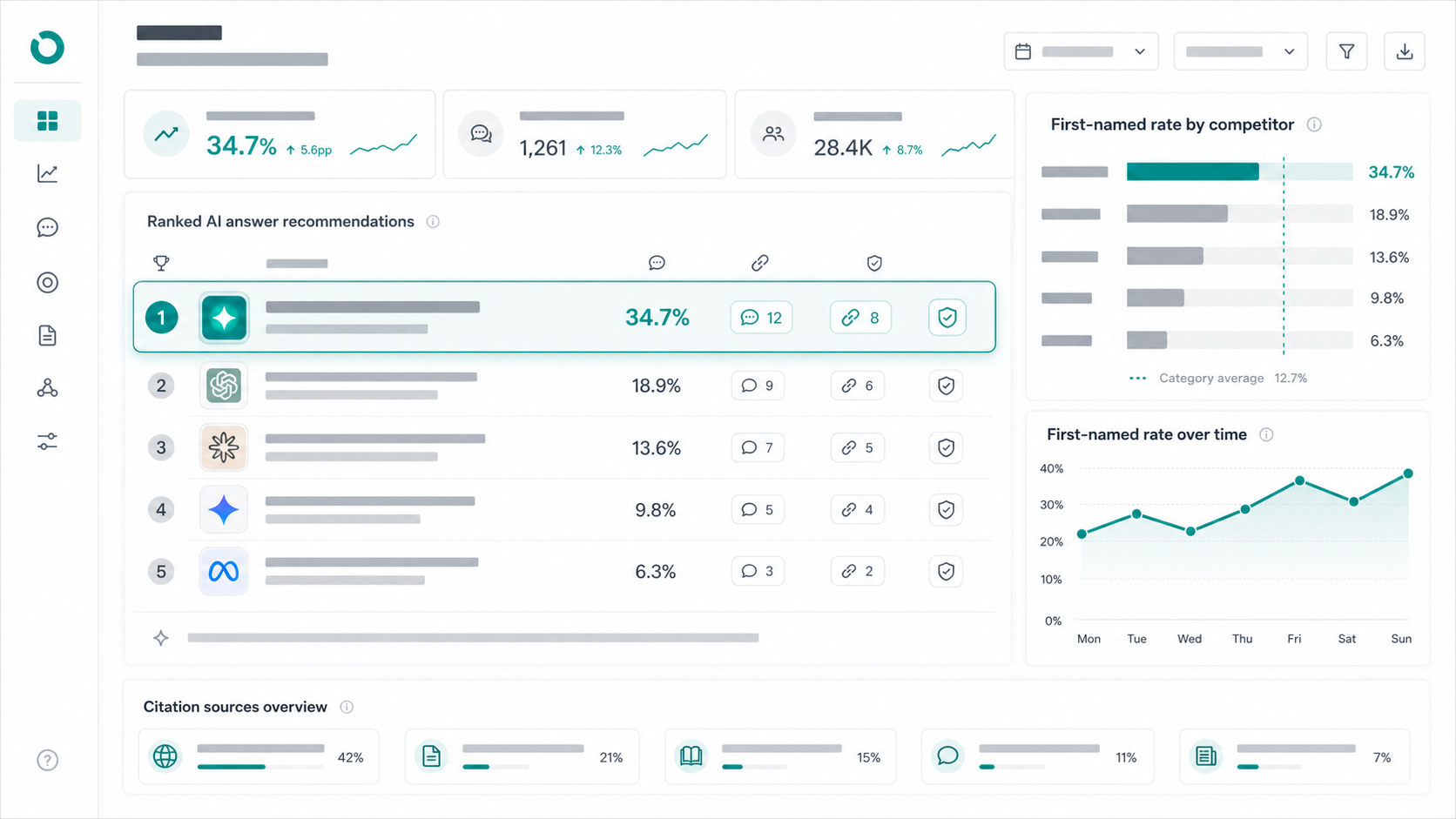
Use this alongside ChatGPT recommendation tracking, ChatGPT share of voice, ChatGPT citation tracking, and AI search competitor mentions. Recommendation tracking classifies the outcome. Share of voice tells you whether ChatGPT names you. Citation tracking tells you whether it links to you. First-named rate tells you whether you are the first brand a buyer sees.
What is ChatGPT first-named rate?
ChatGPT first-named rate is the percentage of relevant ChatGPT prompt runs where your brand is the first vendor, product, or source named in the generated answer. It is a position metric for AI recommendations, similar in spirit to rank tracking, but measured inside generated answers instead of search result pages.
ChatGPT first-named rate is the top-position layer of ChatGPT SEO measurement. A brand can have a healthy mention rate and still lose the buyer's attention if competitors are consistently named first. Track it when the answer contains a ranked list, shortlist, comparison, or recommendation set.
OpenAI's ChatGPT Search documentation says ChatGPT answers can include links to web sources and a sources panel. For marketers, that creates two separate jobs: earn the recommendation position and earn the cited source. First-named rate measures the first job.
When should you measure first-named rate?
Measure first-named rate when the prompt asks ChatGPT to choose, recommend, compare, rank, or shortlist options. Do not use it on prompts where ChatGPT is defining a concept, explaining a workflow, or answering a factual question with no vendor list.
Use this decision table:
| Prompt type | Example ChatGPT query | Track first-named rate? | Primary companion metric |
|---|---|---|---|
| Tool shortlist | "best AI visibility tools for B2B SaaS" | Yes | Share of voice |
| Alternative | "best Otterly alternative for weekly AI search reporting" | Yes | Citation rate |
| Comparison | "Tracemetry vs Profound for ChatGPT SEO" | Yes, if a winner is named | Answer accuracy |
| Workflow | "how do I track ChatGPT citations weekly" | Sometimes | Cited URL quality |
| Definition | "what is generative engine optimization" | No | Mention rate or citation rate |
| Branded support | "how do I use Tracemetry reports" | No | Answer accuracy |
The painful miss is not "we were mentioned fourth." The painful miss is "ChatGPT opened with a competitor for the exact buying prompt our sales team cares about." That is the row to fix first.
How do you calculate ChatGPT first-named rate?
Calculate first-named rate by dividing the number of relevant prompt runs where your brand appears first by the number of relevant prompt runs that produced a vendor, product, or source list. Keep the denominator strict so the metric stays useful.
Use this formula:
ChatGPT first-named rate = first-named runs / recommendation-list runs
Example weekly scorecard:
| Prompt bucket | Recommendation-list runs | Your brand first | First-named rate | What it means |
|---|---|---|---|---|
| Shortlist prompts | 30 | 6 | 20% | You appear, but competitors usually lead |
| Alternatives prompts | 18 | 8 | 44% | Your switcher positioning is working |
| Comparison prompts | 15 | 3 | 20% | The page or proof layer needs work |
| Workflow prompts | 12 | 2 | 17% | Useful, but lower priority than shortlist |
Do not count a prompt if the user already named your brand and ChatGPT simply repeats it first. That is not a recommendation win. Count only cases where ChatGPT had a meaningful choice.
What should you record for each answer?
Record the full recommendation order, not just whether your brand appeared. First-named rate depends on position, so the row needs enough detail to explain why a competitor took the first slot and what page should change.
Minimum fields:
- Prompt
- Prompt bucket: shortlist, alternative, comparison, workflow, or failure mode
- Surface: ChatGPT, ChatGPT Search, or another surface if you are running a cross-surface report
- Date
- First named brand
- All brands named, in order
- Your brand position
- Cited URLs
- Citation order
- Whether the answer gave a direct recommendation or a neutral list
- Loss reason
- Target page to fix
- Re-measure date
If you already run an AI visibility report, add first-named rate as a separate column. Do not bury it inside a blended score. A blended score can hide the exact prompt where a competitor became the default recommendation.
How is first-named rate different from share of voice and citation rate?
First-named rate measures position. Share of voice measures presence against competitors. Citation rate measures source ownership. You need all three because ChatGPT can name you, rank you behind competitors, and cite a different domain in the same answer.
Use this metric map:
| Metric | Formula | Question it answers |
|---|---|---|
| Mention rate | Prompt runs naming your brand / total prompt runs | Does ChatGPT include us? |
| ChatGPT share of voice | Your mentions / approved brand mentions | Are we named more than competitors? |
| First-named rate | Runs where your brand is first / recommendation-list runs | Are we the default recommendation? |
| Citation rate | Runs citing your domain / total prompt runs | Does ChatGPT use our site as evidence? |
| First-named-and-cited rate | Runs where you are first and your domain is cited / recommendation-list runs | Are we both recommended and sourced? |
The strongest win is first-named and cited. The weakest "win" is a trailing mention with no citation, especially on a decision-stage prompt. Treat those as partial wins, not proof that ChatGPT SEO is working.
Why does ChatGPT name a competitor first?
ChatGPT usually names a competitor first when the public source map makes that competitor easier to recommend for the exact prompt. The cause may be page intent, category clarity, third-party proof, freshness, citation strength, or the wording of the prompt itself.
Classify first-position losses before writing anything:
| Loss pattern | Likely cause | First fix |
|---|---|---|
| Competitor first, you absent | Missing page or weak entity clarity | Create or update the page that directly answers the prompt |
| Competitor first, you second | Weaker proof or positioning | Add sharper decision criteria, examples, and current product details |
| You cited, competitor first | Your page informs the answer but does not sell the choice | Add "choose us if..." guidance and stronger CTA copy |
| You first in generic prompts, not buyer prompts | Top-funnel content is stronger than commercial content | Prioritize comparison, alternatives, and use-case pages |
| First place changes every run | Prompt set or sample size is too small | Use three samples for high-intent prompts and report weekly movement |
Bing's webmaster guidance, Google's AI feature guidance, and Google's structured data documentation all point to the same practical operating rule: make important content crawlable, visible, current, and easy to understand. For first-named rate, that means the page needs to make the choice obvious, not merely define the category.
How do you improve first-named rate?
Improve first-named rate by fixing the highest-intent prompt where ChatGPT names a competitor first. The shortest path is usually not a generic new article. It is a sharper buyer-intent page that gives ChatGPT a defensible reason to put your brand first.
Use this checklist:
- Pick the 10 prompts where first position would matter commercially.
- Save the exact answer and the full brand order.
- Inspect the first-named competitor's cited pages and third-party mentions.
- Identify the Tracemetry page that should have owned the prompt.
- Add a 40-80 word direct answer near the top of that page.
- Add a decision table that says who should choose which option and why.
- Add current product details, pricing context, screenshots, or examples where relevant.
- Make entity language explicit: category, audience, use case, integrations, competitors, and surface.
- Add visible FAQ content that matches schema output.
- Link to the page from related cluster posts and product pages.
- Re-measure the same prompt after 7-14 days.
For Tracemetry, the loop is straightforward: run the free AI visibility audit, find prompts where competitors are first, turn those rows into source-grounded briefs, publish or update the target pages, then re-measure inside Tracemetry Pro.
What should a weekly report show?
A useful weekly first-named report should be short enough for leadership and specific enough for the content owner. Show the score, the prompts behind it, the competitors taking first position, the citations shaping the answer, and the next page fixes.
Minimum report structure:
| Section | What to include |
|---|---|
| Scoreboard | First-named rate, mention rate, share of voice, citation rate |
| Top wins | Prompts where your brand moved into first position |
| Top losses | High-intent prompts where a competitor is first |
| Source layer | URLs cited when each first-position answer appeared |
| Fix queue | Page to update, owner, expected re-measure date |
| Watchlist | Prompts with volatile first-position movement |
The report should end with one action: update a source page, publish a missing comparison or alternatives page, correct stale product facts, or build third-party proof. If the report ends with "monitor next week" every time, the metric is not changing behavior.
FAQ
What is ChatGPT first-named rate? ChatGPT first-named rate is the percentage of relevant ChatGPT recommendation-list answers where your brand is the first vendor, product, or source named. It measures whether you are the default recommendation, not just whether you appear somewhere in the answer.
Is first-named rate the same as ChatGPT share of voice? No. ChatGPT share of voice measures how often your brand is named compared with competitors. First-named rate measures whether your brand appears first when ChatGPT gives recommendations. A brand can have strong share of voice but weak first-named rate.
Should I track first-named rate for every prompt? No. Track it for shortlist, alternatives, comparison, and decision-stage workflow prompts. Do not track it for pure definition prompts or support prompts where there is no meaningful ranked recommendation.
How many prompts do I need for first-named tracking? Start with 40-80 prompts for a stable ChatGPT SEO program, then mark the subset that can produce ranked recommendations. Use three samples for high-intent prompts when first position affects the weekly decision.
What is the fastest way to improve first-named rate? Fix the highest-intent prompt where a competitor is first and your brand is absent or lower in the answer. Update the page that should own the prompt with a direct answer, decision table, clear entity language, current proof, internal links, and matching FAQ content.
Should citations count toward first-named rate? No. Keep citations separate. First-named rate measures recommendation position; citation rate measures source ownership. The strongest result is when your brand is first and your domain is cited in the same answer.
Start with the first recommendation buyers actually see
Run the free Tracemetry audit to see where ChatGPT, Claude, and Perplexity mention your brand, cite your site, and recommend competitors. If the first-position gaps matter, use Tracemetry Pro to track the full prompt set, generate source-grounded briefs, publish the fixes, and re-measure whether your brand becomes the first recommendation.
Sources: OpenAI ChatGPT Search, Google AI features and your website, Google structured data introduction, Bing Webmaster Guidelines.
Frequently asked questions
What is ChatGPT first-named rate?
ChatGPT first-named rate is the percentage of relevant ChatGPT recommendation-list answers where your brand is the first vendor, product, or source named. It measures whether you are the default recommendation, not just whether you appear somewhere in the answer.
Is first-named rate the same as ChatGPT share of voice?
No. ChatGPT share of voice measures how often your brand is named compared with competitors. First-named rate measures whether your brand appears first when ChatGPT gives recommendations. A brand can have strong share of voice but weak first-named rate.
Should I track first-named rate for every prompt?
No. Track it for shortlist, alternatives, comparison, and decision-stage workflow prompts. Do not track it for pure definition prompts or support prompts where there is no meaningful ranked recommendation.
How many prompts do I need for first-named tracking?
Start with 40-80 prompts for a stable ChatGPT SEO program, then mark the subset that can produce ranked recommendations. Use three samples for high-intent prompts when first position affects the weekly decision.
What is the fastest way to improve first-named rate?
Fix the highest-intent prompt where a competitor is first and your brand is absent or lower in the answer. Update the page that should own the prompt with a direct answer, decision table, clear entity language, current proof, internal links, and matching FAQ content.
Should citations count toward first-named rate?
No. Keep citations separate. First-named rate measures recommendation position; citation rate measures source ownership. The strongest result is when your brand is first and your domain is cited in the same answer.
See your own AI visibility today.
Free public report. 60 seconds. No signup. Or get started on Pro to track 250 prompts continuously.