Answer engine optimization for financial services
A compliance-aware financial-services AEO workflow for governing rates, fees, eligibility, disclosures, citations, and material-claim accuracy.
Financial-services customers now ask ChatGPT, Gemini, Perplexity, and Google AI results to compare accounts, explain fees, shortlist providers, and interpret eligibility rules. A confident answer built from an expired rate page or an unaffiliated comparison site can create a compliance problem before a prospect reaches your website.
Use this fast rule: track 40 high-value customer questions, assign every factual claim to an approved source page, and route material changes through the same review process used for customer-facing content. Recheck the unchanged questions weekly. This creates a measurable AI visibility loop without giving an AI system permission to invent advice.
This guide extends the B2B AEO source-page playbook, AI answer accuracy workflow, and AEO metrics framework for banks, lenders, wealth platforms, payments companies, and fintech teams. Insurers can use the dedicated insurance AEO playbook for coverage, exclusions, policy editions, and claims guidance.
What is answer engine optimization for financial services?
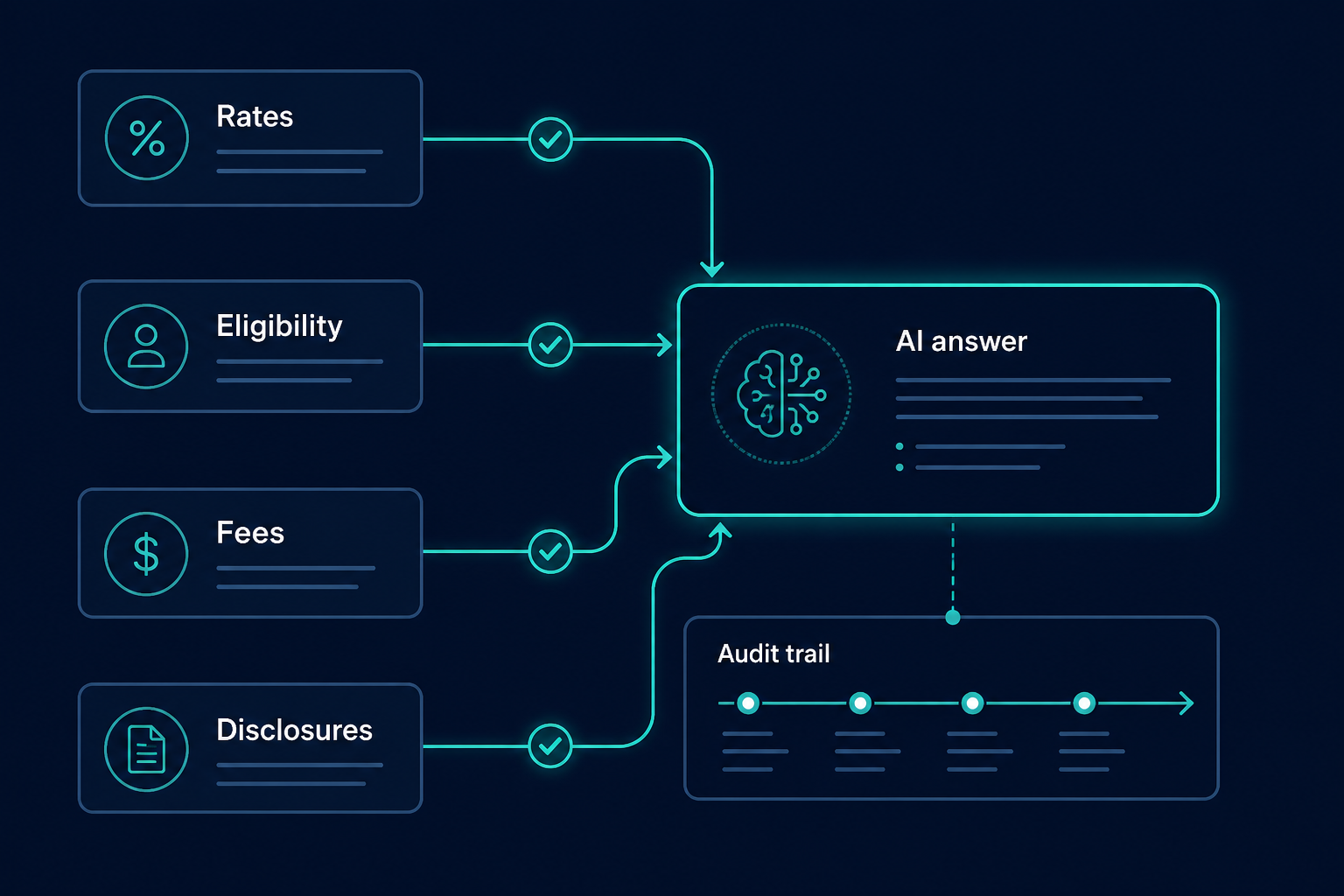
Answer engine optimization for financial services is the process of improving how AI systems describe, cite, compare, and recommend regulated financial products. It connects customer questions to approved pages for rates, fees, eligibility, risks, disclosures, and support, then measures whether generated answers use the correct source and remain factually accurate.
Financial-services AEO is controlled source-of-truth management for AI-assisted discovery. It complements SEO, compliance review, product marketing, and reputation monitoring. It does not guarantee a citation, replace required disclosures, or turn general educational content into personalized financial advice.
Which financial questions should you track first?
Track questions that can change a customer's shortlist, application, transfer, or support decision. Start with product fit, eligibility, current costs, comparisons, risk, process, and failure modes. Keep the first cohort stable so a change in results reflects the answer rather than a rewritten test.
A useful 40-question baseline includes:
- 6 category and product-discovery questions;
- 8 eligibility and suitability questions;
- 8 fees, rates, limits, and timing questions;
- 6 comparison and alternative questions;
- 6 risk, protection, and disclosure questions;
- 6 application, support, and failure-mode questions.
Use natural wording: “how do I compare business current accounts?”, “why does this lender charge an origination fee?”, “what is the best way to choose a payment processor?”, and “when should I contact my bank about an unauthorized transfer?” Tag questions that could invite personalized advice and evaluate whether the answer adds appropriate context instead of overstating certainty.
Which page should own each financial answer?
Give every material claim one approved owner. Product pages should own product features, rate or pricing pages should own current numbers, eligibility pages should own qualification rules, and policy or disclosure pages should own risks and limitations. Educational articles can explain concepts, but they should link to—not paraphrase away—the current product source.
| Customer question | Best source-page owner | Evidence that must stay current |
|---|---|---|
| “What interest rate does this account pay?” | Rate or product page | Rate, balance tiers, effective date, variable/fixed status |
| “Am I eligible to apply?” | Eligibility page | Geography, age, entity type, checks, exclusions |
| “What will this transfer cost?” | Fee or pricing page | Fee basis, currency assumptions, third-party charges |
| “How is my money protected?” | Protection or disclosure page | Applicable scheme, limits, entity, exclusions |
| “How does this product compare?” | Approved comparison page | Consistent criteria, dates, tradeoffs, methodology |
| “What happens if a payment fails?” | Help or policy page | Timeline, status definitions, fees, escalation path |
When two pages disagree, do not publish a third explanation. Choose the authoritative owner, correct the conflict, and add descriptive links from supporting pages.
How do you build a compliance-aware AEO baseline?
Preserve the exact prompt, complete answer, cited URLs, timestamp, market, language, and test conditions. Then review visibility and risk separately. A brand mention can be commercially positive while the surrounding answer contains an outdated rate, unsupported comparison, or missing limitation.
For each test, record:
- whether the brand or product is absent, mentioned, shortlisted, or recommended;
- every cited domain and exact source URL;
- each material claim about rates, fees, eligibility, protection, performance, or risk;
- whether the intended approved page was cited;
- the claim's accuracy, effective date, and review owner;
- the severity and next corrective action.
Use at least two queues: an optimization queue for missing or weak source ownership, and a risk queue for incorrect material claims. A high-severity error should not wait for the next content sprint.
What makes a financial page easier to cite accurately?
The strongest source page answers one question early, uses specific current facts, shows an effective date, names important conditions, and links to the full disclosure or policy. It should be understandable without hiding decisive information behind promotional copy, an image, or an inaccessible document.
Use this source-page checklist:
- Put a 40–80 word direct answer below the relevant heading.
- State the product, provider entity, market, audience, and use case precisely.
- Show rates, fees, limits, and effective dates in readable HTML where possible.
- Place qualifications and meaningful exclusions beside the claim they constrain.
- Link to approved disclosures, terms, methodology, and support routes descriptively.
- Keep authorship, reviewer, and last-updated information visible.
- Maintain canonicals, indexability, sitemaps, and valid structured data.
- Remove or redirect expired campaign, rate, and product pages deliberately.
Google's structured data policies require markup to represent visible page content accurately. Structured data may clarify a page, but it cannot guarantee an AI citation or compensate for conflicting product facts.
How should financial teams handle PDFs and disclosures?
Keep required documents available, but do not make a PDF the only understandable source for a frequently asked product question. Provide an accessible HTML summary with the current answer, effective date, key conditions, and a clear link to the controlling document. Review both versions together whenever the product changes.
PDFs often have stable legal value but weak operational context. File names, scanned text, duplicate versions, and missing internal links can make it difficult to identify the current source. Maintain a version owner, retirement process, canonical landing page, and archive policy so an old document does not remain the easiest retrievable answer.
How do you monitor rates, fees, and other changing facts?
Create a claim registry for facts that can change. Each record should include the claim, authoritative URL, owner, effective date, expiry or review date, affected products, and severity if wrong. Recheck high-value prompts immediately after a material change and on a scheduled cadence between releases.
Prioritize facts in this order:
- customer-harm or regulatory-risk claims;
- current rates, fees, eligibility, limits, and protection information;
- product availability, application steps, and support routes;
- comparisons, awards, performance statements, and market claims;
- general educational definitions.
The wrong AI answers response guide explains how to distinguish a source problem from retrieval lag, third-party evidence, or normal answer variation.
Which metrics matter for financial-services AEO?
Report target-page citation rate, material-claim accuracy, qualified recommendation rate, and error-resolution time separately. One composite visibility score is not enough: it can improve while a critical fee or eligibility statement remains wrong.
| Metric | What it answers | Important caveat |
|---|---|---|
| Target-page citation rate | Is the approved page being used? | A citation can still support a wrong interpretation |
| Material-claim accuracy | Are consequential facts correct? | Requires human review and an effective date |
| Qualified recommendation rate | Is the product recommended for an appropriate need? | Suitability language needs careful review |
| Competitor source share | Which domains own the comparison? | Visibility alone does not prove source quality |
| Error-resolution time | How quickly are serious errors addressed? | Separate source fixes from engine refresh time |
Connect AI observations to site visits, applications, support contacts, and approved campaign reporting where attribution permits. Do not claim that a citation caused revenue when the evidence only shows correlation.
What financial AEO mistakes create the most risk?
The most expensive mistakes are optimizing for mentions without reviewing accuracy, copying disclosures into multiple unmanaged pages, and treating one generated response as a stable result. Teams also fail when marketing owns visibility but nobody owns product facts after publication.
Avoid these failure modes:
- publishing personalized-sounding guidance as a generic acquisition tactic;
- hiding decisive conditions far from the claim they qualify;
- leaving expired rate pages and old PDFs indexable without context;
- using comparison tables with mixed dates or inconsistent criteria;
- adding schema that overstates what the visible page says;
- measuring only brand mentions and ignoring material errors;
- changing the prompt set every week and calling movement improvement;
- promising that technical markup will force an AI system to cite the page.
FAQ
Does financial-services AEO replace SEO or compliance review?
No. Technical SEO, useful content, authority, internal links, and conversion paths still support discovery. Compliance review remains essential for regulated claims. AEO adds question-level monitoring of generated answers, citations, competitors, source ownership, and factual accuracy.
How many AI prompts should a financial brand track?
Start with about 40 high-value questions for one product, audience, and market. Expand only after the team can preserve raw answers, review material claims, assign authoritative pages, fix errors, and repeat the stable cohort consistently.
What is the best financial-services AEO metric?
Material-claim accuracy is the primary safety metric. Pair it with target-page citation rate and qualified recommendation rate so the team knows whether an approved source appears, whether the answer is correct, and whether the recommendation fits the tested need.
Can schema markup guarantee an AI citation?
No. Structured data can clarify visible content for systems that use it, but it does not guarantee retrieval, ranking, citation, or recommendation. The page still needs accessible, current, specific evidence and consistent supporting sources.
How often should changing financial facts be checked?
Recheck priority prompts whenever rates, fees, eligibility, limits, protection information, or availability changes. During normal operations, review high-risk questions weekly and maintain a scheduled source audit with clear owners and effective dates.
What is the first financial AEO action to take?
Choose 40 consequential customer questions and capture the current answers, citations, and material claims. Flag incorrect rates, fees, eligibility rules, protection statements, and support instructions before creating new content, then map each question to one approved source page.
Build a controlled AI visibility loop
Financial-services AEO works when product facts, compliance review, source pages, and repeated answer monitoring share one operating system. Start with one product and one market, fix the ten most consequential gaps, and preserve the evidence behind every decision. Run a Tracemetry AI visibility audit or book a demo to monitor answers, citations, competitors, and material claim changes in one recurring workflow.
Frequently asked questions
Does financial-services AEO replace SEO or compliance review?
No. Technical SEO, useful content, authority, internal links, and conversion paths still support discovery. Compliance review remains essential for regulated claims. AEO adds question-level monitoring of generated answers, citations, competitors, source ownership, and factual accuracy.
How many AI prompts should a financial brand track?
Start with about 40 high-value questions for one product, audience, and market. Expand only after the team can preserve raw answers, review material claims, assign authoritative pages, fix errors, and repeat the stable cohort consistently.
What is the best financial-services AEO metric?
Material-claim accuracy is the primary safety metric. Pair it with target-page citation rate and qualified recommendation rate so the team knows whether an approved source appears, whether the answer is correct, and whether the recommendation fits the tested need.
Can schema markup guarantee an AI citation?
No. Structured data can clarify visible content for systems that use it, but it does not guarantee retrieval, ranking, citation, or recommendation. The page still needs accessible, current, specific evidence and consistent supporting sources.
How often should changing financial facts be checked?
Recheck priority prompts whenever rates, fees, eligibility, limits, protection information, or availability changes. During normal operations, review high-risk questions weekly and maintain a scheduled source audit with clear owners and effective dates.
What is the first financial AEO action to take?
Choose 40 consequential customer questions and capture the current answers, citations, and material claims. Flag incorrect rates, fees, eligibility rules, protection statements, and support instructions before creating new content, then map each question to one approved source page.
See your own AI visibility today.
Free public report. 60 seconds. No signup. Or get started on Pro to track 250 prompts continuously.